Tuesday, August 10, 2010

The Product Life Cycle

0 comments

A new product progresses through a sequence of stages from introduction to growth, maturity, and decline. This sequence is known as the product life cycle and is associated with changes in the marketing situation, thus impacting the marketing strategy and the marketing mix.

product_life_cycle

The product revenue and profits can be plotted as a function of the life-cycle stages as shown in the graph below:

Introduction Stage

In the introduction stage, the firm seeks to build product awareness and develop a market for the product. The impact on the marketing mix is as follows:

  • Product branding and quality level is established, and intellectual property protection such as patents and trademarks are obtained.
  • Pricing may be low penetration pricing to build market share rapidly, or high skim pricing to recover development costs.
  • Distribution is selective until consumers show acceptance of the product.
  • Promotion is aimed at innovators and early adopters. Marketing communications seeks to build product awareness and to educate potential consumers about the product.

Growth Stage

In the growth stage, the firm seeks to build brand preference and increase market share.

  • Product quality is maintained and additional features and support services may be added.
  • Pricing is maintained as the firm enjoys increasing demand with little competition.
  • Distribution channels are added as demand increases and customers accept the product.
  • Promotion is aimed at a broader audience.

Maturity Stage

At maturity, the strong growth in sales diminishes. Competition may appear with similar products. The primary objective at this point is to defend market share while maximizing profit.

  • Product features may be enhanced to differentiate the product from that of competitors.
  • Pricing may be lower because of the new competition.
  • Distribution becomes more intensive and incentives may be offered to encourage preference over competing products.
  • Promotion emphasizes product differentiation.

Decline Stage

As sales decline, the firm has several options:

  • Maintain the product, possibly rejuvenating it by adding new features and finding new uses.
  • Harvest the product - reduce costs and continue to offer it, possibly to a loyal niche segment.
  • Discontinue the product, liquidating remaining inventory or selling it to another firm that is willing to continue the product.

The marketing mix decisions in the decline phase will depend on the selected strategy. For example, the product may be changed if it is being rejuvenated, or left unchanged if it is being harvested or liquidated. The price may be maintained if the product is harvested, or reduced drastically if liquidated.

marketing mix

Sunday, August 8, 2010

Mergers and Acquisitions

0 comments

The Main Idea

One plus one makes three: this equation is the special alchemy of a merger or an acquisition. The key principle behind buying a company is to create shareholder value over and above that of the sum of the two companies. Two companies together are more valuable than two separate companies - at least, that's the reasoning behind M&A.

mergers-and-acquisitions
This rationale is particularly alluring to companies when times are tough. Strong companies will act to buy other companies to create a more competitive, cost-efficient company. The companies will come together hoping to gain a greater market share or to achieve greater efficiency. Because of these potential benefits, target companies will often agree to be purchased when they know they cannot survive alone.

Distinction between Mergers and Acquisitions

Although they are often uttered in the same breath and used as though they were synonymous, the terms merger and acquisition mean slightly different things. When one company takes over another and clearly established itself as the new owner, the purchase is called an acquisition
In the pure sense of the term, a merger happens when two firms, often of about the same size, agree to go forward as a single new company rather than remain separately owned and operated. This kind of action is more precisely referred to as a "merger of equals." Both companies' stocks are surrendered and new company stock is issued in its place. For example, both Daimler-Benz and Chrysler ceased to exist when the two firms merged, and a new company, DaimlerChrysler, was created.
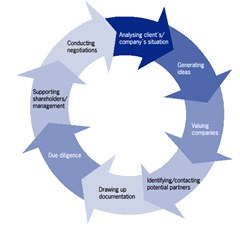
mergers_and_acquisitions_en
In practice, however, actual mergers of equals don't happen very often. Usually, one company will buy another and, as part of the deal's terms, simply allow the acquired firm to proclaim that the action is a merger of equals, even if it's technically an acquisition. Being bought out often carries negative connotations, therefore, by describing the deal as a merger, deal makers and top managers try to make the takeover more palatable.

Varieties of Mergers

From the perspective of business structures, there is a whole host of different mergers. Here are a few types, distinguished by the relationship between the two companies that are merging

Horizental Merger

Two companies that are in direct competition and share the same product lines and markets

Vertical Merger

A customer and company or a supplier and company. Think of a cone supplier merging with an ice cream maker.
Market-extension merger - Two companies that sell the same products in different markets.
Product-extension merger - Two companies selling different but related products in the same market.

Acquisitions

As you can see, an acquisition may be only slightly different from a merger. In fact, it may be different in name only. Like mergers, acquisitions are actions through which companies seek economies of scale, efficiencies and enhanced market visibility. Unlike all mergers, all acquisitions involve one firm purchasing another - there is no exchange of stock or consolidation as a new company. Acquisitions are often congenial, and all parties feel satisfied with the deal. Other times, acquisitions are more hostile.
In an acquisition, as in some of the merger deals we discuss above, a company can buy another company with cash, stock or a combination of the two. Another possibility, which is common in smaller deals, is for one company to acquire all the assets of another company. Company X buys all of Company Y's assets for cash, which means that Company Y will have only cash (and debt, if they had debt before). Of course, Company Y becomes merely a shell and will eventually liquidate or enter another area of business.
Another type of acquisition is a reverse merger, a deal that enables a private company to get publicly-listed in a relatively short time period. A reverse merger occurs when a private company that has strong prospects and is eager to raise financing buys a publicly-listed shell company, usually one with no business and limited assets. The private company reverse merges into the public company, and together they become an entirely new public corporation with tradable shares. Regardless of their category or structure, all mergers and acquisitions have one common goal: they are all meant to create synergy that makes the value of the combined companies greater than the sum of the two parts. The success of a merger or acquisition depends on whether this synergy is achieved.

Valuation Matters

Investors in a company that are aiming to take over another one must determine whether the purchase will be beneficial to them. In order to do so, they must ask themselves how much the company being acquired is really worth.
Naturally, both sides of an M&A deal will have different ideas about the worth of a target company: its seller will tend to value the company at as high of a price as possible, while the buyer will try to get the lowest price that he can. There are, however, many legitimate ways to value companies. The most common method is to look at comparable companies in an industry, but deal makers employ a variety of other methods and tools when assessing a target company. Here are just a few of them:

Comparative Ratios - The following are two examples of the many comparative metrics on which acquiring companies may base their offers:
Price-Earnings Ratio (P/E Ratio) - With the use of this ratio, an acquiring company makes an offer that is a multiple of the earnings of the target company. Looking at the P/E for all the stocks within the same industry group will give the acquiring company good guidance for what the target's P/E multiple should be.
Enterprise-Value-to-Sales Ratio (EV/Sales) - With this ratio, the acquiring company makes an offer as a multiple of the revenues, again, while being aware of the price-to-sales ratio of other companies in the industry.
Replacement Cost - In a few cases, acquisitions are based on the cost of replacing the target company. For simplicity's sake, suppose the value of a company is simply the sum of all its equipment and staffing costs. The acquiring company can literally order the target to sell at that price, or it will create a competitor for the same cost. Naturally, it takes a long time to assemble good management, acquire property and get the right equipment. This method of establishing a price certainly wouldn't make much sense in a service industry where the key assets - people and ideas - are hard to value and develop.
Discounted Cash Flow (DCF) - A key valuation tool in M&A, discounted cash flow analysis determines a company's current value according to its estimated future cash flows. Forecasted free cash flows (net income + depreciation/amortization - capital expenditures - change in working capital) are discounted to a present value using the company's weighted average costs of capital (WACC). Admittedly, DCF is tricky to get right, but few tools can rival this valuation method.

Synergy: The Premium for Potential Success

For the most part, acquiring companies nearly always pay a substantial premium on the stock market value of the companies they buy. The justification for doing so nearly always boils down to the notion of synergy; a merger benefits shareholders when a company's post-merger share price increases by the value of potential synergy. Let's face it, it would be highly unlikely for rational owners to sell if they would benefit more by not selling. That means buyers will need to pay a premium if they hope to acquire the company, regardless of what pre-merger valuation tells them. For sellers, that premium represents their company's future prospects. For buyers, the premium represents part of the post-merger synergy they expect can be achieved. The following equation offers a good way to think about synergy and how to determine whether a deal makes sense. The equation solves for the minimum required synergy: In other words, the success of a merger is measured by whether the value of the buyer is enhanced by the action. However, the practical constraints of mergers, which we discuss in part five, often prevent the expected benefits from being fully achieved. Alas, the synergy promised by deal makers might just fall short.

Conclusion

One size doesn't fit all. Many companies find that the best way to get ahead is to expand ownership boundaries through mergers and acquisitions. For others, separating the public ownership of a subsidiary or business segment offers more advantages. At least in theory, mergers create synergies and economies of scale, expanding operations and cutting costs. Investors can take comfort in the idea that a merger will deliver enhanced market power.
By contrast, de-merged companies often enjoy improved operating performance thanks to redesigned management incentives. Additional capital can fund growth organically or through acquisition. Meanwhile, investors benefit from the improved information flow from de-merged companies. M&A comes in all shapes and sizes, and investors need to consider the complex issues involved in M&A. The most beneficial form of equity structure involves a complete analysis of the costs and benefits associated with the deals

Saturday, August 7, 2010

Fiscal and Monetary Policy

0 comments

Fiscal Policy

Fiscus (in Latin) refers to a purse and ‘fisc’ (in English) is a royal or state treasury. Thus, ‘fiscal policy’ is that under which the government uses its revenue and expenditure programs to produce desirable effects on national income, production and economy. It is thus used as a balancing device in the economy. Two major elements of fiscal policy are taxation and public expenditure.

fixitFiscalPolicy

Objectives of fiscal policy

The role of fiscal policy in developed economies is to maintain full employment and stabilize growth. In contrast, in developing countries, fiscal policy is used to create an environment for rapid economic growth. The various aspects of this are:

  1. Mobilization of resources: Developing economies are characterized by low levels of income and investment, which are linked in a vicious circle. This can be successfully broken by mobilizing resources for investment energetically.
  2. Acceleration of economic growth: The government has not only to mobilize more resources for investment, but also to direct the resources to those channels where the yield is higher and the goods produced are socially acceptable.
  3. Minimization of the inequalities of income and wealth: Fiscal tools can be used to bring about the redistribution of income in favor of the poor by spending revenue so raised on social welfare activities.
  4. Increasing employment opportunities: Fiscal incentives, in the form of tax-rebates and concessions, can be used to promote the growth of those industries that have high employment-generation potential.
  5. Price stability: Fiscal tools can be employed to contain inflationary and deflationary tendencies in the economy.

The limitations of Fiscal Policy

Fiscal policy has been a great success in developed countries but only partially so in developing countries. The tax structure in the developing countries is rigid and narrow. Thus, conditions conducive to the growth of well-knit and integrated tax policies are absent and sorely missed. Following are some of the reasons that are hindrances for its implementation in developing countries:

  1. A sizeable portion of most developing economies is non-monetized, rendering fiscal measures of the government ineffective and self-defeating.
  2. Lack of statistical information as regards the income, expenditure, savings, investment, employment etc. makes it difficult for the public authorities to formulate a rational and effective fiscal policy.
  3. Fiscal policy cannot succeed unless people understand its implications and cooperate with the government in its implication. This is due to the fact that, in developing countries, a majority of the people are illiterate.
  4. Large-scale tax evasion, by people who are not conscious of their roles in development, has an impact on fiscal policy.
  5. Fiscal policy requires efficient administrative machinery to be successful. Most developing economies have corrupt and inefficient administrations that fail to implement the requisite measures vis-à-vis the implementation of fiscal policy.

Among the various tools of fiscal policy, the following are the most important

Reflationary Fiscal Policy

It may be used to boost the level of economic activity during periods of recession or deceleration in economic activity. This is done by lowering taxes or increasing government expenditure.

Deflationary Fiscal Policy

During a boom, i.e., when the economy is growing beyond its capacity, inflation and balance of payment problems might result. This can be achieved by increasing taxes or by reducing government expenditure.

It would perhaps be too simplistic to conclude that fiscal policy is the most important tool of financial correction and consolidation, especially that undertaken by the government. However, there is no reason to neglect this very powerful tool that is in the hands of governments and central banks the world over. Used properly, fiscal policy can determine the broad direction the economy of a given country is going to take.

Monetary policy

Monetary policy is the process to manage the supply of money in such that specific goals such price stability, employment etc are achieved. A central bank's measures to influence short-term interest rates and the supply of money and credit, to promote national economic goals are another way to define monetary policy. It has two basic goals: to promote maximum sustainable output and employment and to promote stable prices.

sbp  It is given great notice by each country’s government and special bodies are appointed to achieve these goals. In general, these organizations are called central bank and typically serve a role of supervising the smooth operation of the financial system as well as monetary policy. They are generally given liberty to avoid interference of ruling government that can misuse it. It is said to be easy, loose or expansionary when the quantity of money in circulation is being rapidly increased and short-term interest rates are thus being pushed down. Monetary policy is called tight or contraction when the quantity of money available is being reduced and short-term interest rates are thus being pushed to higher levels.

The primary instrument of monetary policy is typically a short term interest rate. Interest rates on loan contracts or debt appliances such as treasury bills, bank certificates of deposit, or commercial paper having maturities less than one year often called money market rates are short term interest rates. In the future, the amount of goods and services the economy produces and the number of jobs it generates both depends on factors other than monetary policy. These include technology and people's preferences for saving, risk, and work effort. So, utmost output and employment mean the levels consistent with these factors in the long run. Currently all central banks in industrialized countries adopt monetary policy through market-oriented instruments geared to influencing short-term interest rates as operating targets. They do so mainly by determining the conditions that stabilize supply and demand in the market for bank reserves.

Factors to be considered

Money Stock

It is the total money available in a particular economy at a particular point in time. Various sorts of things may be serving as money at the same time in any particular economy, exact definition and measurement of the money stock presents some serious practical problems for the policy maker who needs to use manipulation of the growth of the money stock as a tool of economic policy.

Open market operations

Sales or purchases of government debt devices such as treasury bonds, treasury bills, treasury notes on the open financial markets by a nations central bank (in the U.S., the Federal Reserve) as part of its efforts to control the size of the money supply and the levels of interest rates. Central bank verdict to buy up government debt instruments make for an expansionary monetary policy, while sales of government debt instruments by the central bank represent a contractionary monetary policy.

Also a well functioning good and labor market form an important factor of competitiveness within the single monetary policy. Fiscal policy, also plays as an instrument of growth policy, through its effect on national saving by means of the structural budget deficit, through incentive effects on work, saving and investment via tax rates and tax structure, and through public investment in human capital and physical infrastructure.

Price stability is the unique objective for monetary policy for long term. The upsetting effects of price instability in the economy are felt in the form of Business Cycles. When there are rapid changes in the price level there are fluctuations in the level of economic activities also. Price stability means that the average price as found by the wholesale or Consumer Price index fluctuate within a narrow range. Both rise in price level and drop in price level cause disturbances and have bad effects on the economy. A monetary policy may reduce short-term interest rates by flooding the banks and financial markets with funds providing loan and yet at the same time may in fact raise longer-term interest rates by prompting fears among lenders that inflation will soon be speed up.

Sadly, medium and long-term interest rates have much more pressure on the rate of growth of the economy and on levels of unemployment than short-term interest rates do, because major new investment spending like research and development for new products or the construction of whole new factories are long-term projects that require financing, and they are less likely to be undertaken. Monetary policy should therefore very carefully plan and efficiently worked out since it decides the economic growth of a country.

Tuesday, July 20, 2010

Promotion and advertising

1 comments

The answers to these five questions underpin all advertising and promotional strategies:

  1. What do you want to happen?
  2. If that happens, how much is it worth?
  3. What message will make it happen?
  4. What media will work best?
  5. How will you measure the effectiveness of your effort and expense?

What do you want to happen?

Do you want prospective customers to visit your website; phone, write to you or e-mail you; return a card; or send an order in the post? Do you expect them to have an immediate need to which you want them to respond now, or is it that you want them to remember you at some future date when they have a need for whatever it is you are selling?

The more you are able to identify a specific response in terms of orders, visits, phone calls or requests for literature, the better your promotional effort will be tailored to achieve your objective, and the more clearly you will be able to assess the effectiveness of your promotion and its cost versus its yield.

How much is that worth to you?

Once you know what you want a particular promotional activity to achieve,it becomes a little easier to estimate its cost. Suppose a Rs.1,000 advertisement is expected to generate 100 enquiries for your product. If experience tells you that on average 10 per cent of enquiries result in orders, and your profit margin is Rs.200 per product, then you can expect an extra Rs.2,000 profit. That ‘benefit’ is much greater than the Rs.1,000 cost of the advertisement, so it seems a worthwhile investment. Then, with your target in mind, decide how much to spend on advertising each month, revising that figure in the light of experience.

Deciding the message

Your promotional message must be built around facts about the company and about the product. The stress here is on the word ‘fact’, and while there may be many types of fact surrounding you and your products, your customers are interested in only two: the facts that influence their buying decisions, and the ways in which your business and its products stand out from the competition.

These facts must be translated into benefits.There is sometimes an assumption that everyone buys only for obvious, logical reasons, when we all know of innumerable examples showing this is not so. Do people buy new clothes only when the old ones are worn out? Do bosses have desks that are bigger than their subordinates’ because they have more papers to put on them?

The message should follow the AIDA formula: get Attention, capture Interest, create Desire and encourage Action. Looking at each in turn:

Getting attention requires a hook. Color, humor and design are tools used to focus people on your offer and away from the masses of distracting clutter that occupy minds.

Interest is achieved by involving people in some aspect of the product, perhaps by posing a question such as one diet company does with its challenge ‘would you like to loose 2 kg in 2 weeks?’.

Desire is about showing people the end result they could achieve by having or using your product. Every speedboat advertisement has a beautiful girl posing , the inference being that if you owned the boat you would be sure to get the girl too.

Action means provoking a painless way for people to start the buying process. Free trial, money-back guarantee, offer only lasts this week and so forth are examples of the strategies used to achieve this result.

UACCA – Unawareness, Awareness, Comprehension, Conviction, Action is another acronym used in this context.

Choosing the media

Your market research should produce a clear understanding of who your potential customer group are, which in turn will provide pointers as to how to reach them. But even when you know whom you want to reach with your advertising message it’s not always plain sailing.

Above or below the line

Advertising media are usually clustered under two headings, above the line and below the line. It has to be said that the line is becoming increasingly indistinct but it is still a term that is part of the lexicon in seeing the advertising budget.

Above the line

Above the line (ATL) involves using conventional impersonal mass media to promote products and services, talking at the consumer. Major above-the-line techniques include:

  • TV, cinema and radio advertising: The vast array of local newspapers, TV channels and digital radio stations can make this a more targeted advertising strategy than has been the case.
  • Print advertising in newspapers, magazines, directories and classified ads: Print of all forms has the merit of having a long life, so it can be used for handling more complex messages than, say, radio or TV.
  • Internet banner ads act as a point of entry for a more detailed advert.
  • Search engines: Search engine advertising comes in two main forms.
  • PPC (pay per click) is where you buy options on certain key words so that someone searching for a product will see your ‘advertisement’ to the side of the natural search results. Google, for example, offers a deal where you pay only when someone clicks on your ad and you can set a daily budget stating how much you are prepared to spend, with $5 a day as the starting price.
  • Podcasts, where internet users can download sound and video free, are now an important part of the E-advertising armoury.
  • Posters and billboards.

Below the line

Below the line (BTL) talks to the consumer in a more personal way using such media as:

  • Direct mail – leaflets, flyers, brochures: Response rates are notoriously
  • low, less than 1 per cent resulting in sale, but direct mail has the merit of being a proven method of reaching specific targeted market segments.
  • Direct e-mail and viral marketing: The latter is the process of creating something so hot that the recipients will pass it on to friends and colleagues, creating extra demand as it rolls out. Jokes, games, pictures, quizzes and surveys are examples.
  • Sales promotions, including point of sales material: Activities carried out in this area include free samples, try before you buy, discounts, coupons, incentives and rebates, contests, and special events such as fairs and exhibitions.
  • PR (public relations): This is about presenting yourself and your business in a favorable light to your various ‘publics’ – at little or no cost. It is also a more influential method of communication than general advertising – people believe editorials. There may also be times when you have to deal with the press – anything from when you are trying to get attention for a new product to handling an adverse situation, say if your product has to be recalled for quality reasons, or worse.
  • Letterheads, stationery and business cards are often overlooked in the battle for customer attention, but are in fact often the first and perhaps only way in which a business’s image is projected.
  • Blogs, where the opinions and experiences of particular groups of people are shared using online communities such as MySpace, for example, are an extension of this idea. Neilson NetRatings reported in 2008 that over 2 billion community sites are viewed every month in the UK alone.

Push or pull

Like above or below the line, push and pull are different advertising strategies used for achieving different results. Pull advertising is geared to drawing visitors into your net if they are actively looking for your type of product or service. Search engines, listings in on- and off-line directories, Yellow Pages and shopping portals are examples here.

Push advertising tries to get the word out to groups of potential customers in the hope that some of them will be considering making a purchase at about that time. Magazines, newspapers, TV, banner ads and direct mail both on- and off-line are examples here.

As with above and below the line, the distinctions are fast becoming blurred, but the message used in your advertising will be different. With pull there is the assumption that people want to buy, and they just need convincing that they should buy from you. Push calls for a different message convincing them of their need and desire in the first place.

Measuring results

The final step is to measuring performance and evaluate your results.

Aiou IQ Puzzles 1-4

0 comments

IQ

Local Area Networks

0 comments

A local area network (LAN) is a small interconnection infrastructure that typically uses a shared transmission medium. Because of such factors as the volume of traffic, the level of security, and cost, the network structure in a local area network can be significantly different from that for a wide area network.

A LAN is used for communications in a small community in which resources, such as printers, software, and servers, are shared. Each device connected to a LAN has a unique address. Two or more LANs of the same type can also be connected to forward data frames among multiple users of other local area networks. In LANs, packets are additional headers appended for local routing. These new-looking packets are known as frames. Users in a local area network can be interconnected in several ways. The fundamental network topology in LANs can be categorized into bus, ring, and star, as shown in following figure.

Local area networks

Bus Topology

In the bus topology, all users are connected to a common transmission medium referred to as a bus. The users are connected to a common bus via a duplex link that allows both uplink and downlink operations, as seen in the figure. The transmission from a user is propagated on the bus in both directions, and all users in the path receive its frame. However, only the destination user copies the frame into its computer; all other users discard the frame.

Ring Topology

The ring topology comprises of layer 2 devices called repeaters. Repeaters are interconnected to form a closed loop, and each user is connected to one repeater, shown in the figure by a smaller circle. When a user transmits a frame, its associated repeater forwards the frame to the ring. The ring is normally unidirectional, so a frame can flow in one direction. During the circulation of the frame in the ring, the destination user copies the frame onto its buffer. Once copied by the destination, the frame continues its circulation until the sender receives it and removes it from the system. To avoid collision, only one user can transmit at a given time.

Star Topology

In the star topology, all users are directly connected to a central user through two unidirectional links: one for uplink and the other for downlink. The central user functions in either broadcast mode or frame-switch mode. In broadcast mode, the central user is called a hub. When it receives the frame from a user on the uplink, the hub retransmits the frame to all users on the downlink. Broadcast mode allows only one user to transmit at a time. In frame-switch mode, the central user buffers the received frame and retransmits the frame only to the destination.

Friday, July 16, 2010

Banker Customer Relationship

0 comments

RELATIONSHIP BETWEEN PAYOR BANK AND ITS CUSTOMER

When bank may charge account of customer

  • Liability of bank to customer for wrongful dishonor; time of determining insufficiency of account.
  • Right of customer to stop payment; burden of proof of loss
  • Bank not obligated to pay check more than six months old.
  • Death or incapacity of customer
  • Duty of customer to discover and report unauthorized signature or alteration
  • Right of payor bank to subrogation on improper payment.

When bank may charge account of customer

  1. General rule.--A bank may charge against the account of a customer an item that is properly payable from that account even though the charge creates an overdraft. An item is properly payable if it is authorized by the customer and is in accordance with any agreement between the customer and the bank.
  2. Limitation on customer liability.--A customer is not liable for the amount of an overdraft if the customer neither signed the item nor benefited from the proceeds of the item.
  3. Postdated checks.--A bank may charge against the account of a customer a check that is otherwise properly payable from the account, even though payment was made before the date of the check, unless the customer has given notice to the bank of the postdating describing the check with reasonable certainty. The notice is effective for the period stated in section 4403(b) (relating to right of customer to stop payment; burden of proof of loss) for stop-payment orders and must be received at such time and in such manner as to afford the bank a reasonable opportunity to act on it before the bank takes any action with respect to the check described in section 4303 (relating to when items subject to notice, stop-payment order, legal process or set-off; order in which items may be charged or certified). If a bank charges against the account of a customer a check before the date stated in the notice of postdating, the bank is liable for damages for the loss resulting from its act. The loss may include damages for dishonor of subsequent items under section 4402 (relating to liability of bank to customer for wrongful dishonor; time of determining insufficiency of account).
  4. Payment to holder on altered or completed item.--A bank that in good faith makes payment to a holder may charge the indicated account of its customer according to:

Liability of bank to customer for wrongful dishonor; time of determining insufficiency of account

  1. Wrongful dishonor.--Except as otherwise provided in this division, a payor bank wrongfully dishonors an item if it dishonors an item that is properly payable, but a bank may dishonor an item that would create an overdraft unless it has agreed to pay the overdraft.
  2. Liability of bank.--A payor bank is liable to its customer for damages proximately caused by the wrongful dishonor of an item. Liability is limited to actual damages proved and may include damages for an arrest or prosecution of the customer or other consequential damages. Whether any consequential damages are proximately caused by the wrongful dishonor is a question of fact to be determined in each case.
  3. Determination of bank.--A payor bank's determination of the customer's account balance on which a decision to dishonor for insufficiency of available funds is based may be made at any time between the time the item is received by the payor bank and the time that the payor bank returns the item or gives notice in lieu of return, and no more than one determination need be made. If, at the election of the payor bank, a subsequent balance determination is made for the purpose of reevaluating the bank's decision to dishonor the item, the account balance at that time is determinative of whether a dishonor for insufficiency of available funds is wrongful.

Right of customer to stop payment; burden of proof of loss

  1. Right of customer to stop payment.--A customer or any person authorized to draw on the account if there is more than one person may stop payment of any item drawn on the customer's account or close the account by an order to the bank describing the item or account with reasonable certainty received at a time and in a manner that affords the bank a reasonable opportunity to act on it before any action by the bank with respect to the item described in section 4303 (relating to when items subject to notice, stop-payment order, legal process or set-off; order in which items may be charged or certified). If the signature of more than one person is required to draw on an account, any of these persons may stop payment or close the account.
  2. Duration of stop-payment orders.--A stop-payment order is effective for six months, but it lapses after 14 calendar days if the original order was oral and was not confirmed in writing within that period. A stop-payment order may be renewed for additional six-month periods by a writing given to the bank within a period during which the stop-payment order is effective.
  3. Burden of proof of loss.--The burden of establishing the fact and amount of loss resulting from the payment of an item contrary to a stop-payment order or order to close an account is on the customer. The loss from payment of an item contrary to a stop-payment order may include damages for dishonor of subsequent items under section 4402 (relating to liability of bank to customer for wrongful dishonor; time of determining insufficiency of account).

Bank not obligated to pay check more than six months old

A bank is under no obligation to a customer having a checking account to pay a check, other than a certified check, which is presented more than six months after its date, but it may charge the account of its customer for a payment made thereafter in good faith.

Death or incapacity of customer

  1. Authority of bank unaffected in absence of knowledge.--The authority of a payor or collecting bank to accept, pay or collect an item or to account for proceeds of its collection, if otherwise effective, is not rendered ineffective by incapacity of a customer of either bank existing at the time the item is issued or its collection is undertaken if the bank does not know of an adjudication of incapacity. Neither death nor incapacity of a customer revokes the authority to accept, pay, collect or account until the bank knows of the fact of death or of an adjudication of incapacity and has reasonable opportunity to act on it.
  2. Limited authority of bank following knowledge.--Even with knowledge, a bank may for ten days after the date of death pay or certify checks drawn on or before that date unless ordered to stop payment by a person claiming an interest in the account.

Duty of customer to discover and report unauthorized signature or alteration

  1. Statement of account.--A bank that sends or makes available to a customer a statement of account showing payment of items for the account shall either return or make available to the customer the items paid or provide information in the statement of account sufficient to allow the customer reasonably to identify the items paid. The statement of account provides sufficient information if the item is described by item number, amount and date of payment.
  2. Retention of items.--If the items are not returned to the customer, the person retaining the items shall either retain the items or, if the items are destroyed, maintain the capacity to furnish legible copies of the items until the expiration of seven years after receipt of the items. A customer may request an item from the bank that paid the item, and that bank must provide in a reasonable time either the item or, if the item has been destroyed or is not otherwise obtainable, a legible copy of the item.
  3. Duty of customer.--If a bank sends or makes available a statement of account or items pursuant to subsection (a), the customer must exercise reasonable promptness in examining the statement or the items to determine whether any payment was not authorized because of an alteration of an item or because a purported signature by or on behalf of the customer was not authorized. If, based on the statement or items provided, the customer should reasonably have discovered the unauthorized payment, the customer must promptly notify the bank of the relevant facts.
  4. Effect of failure to report unauthorized signature or alteration.--If the bank proves that the customer failed, with respect to an item, to comply with the duties imposed on the customer by subsection (c), the customer is precluded from asserting against the bank:
  5. The customer's unauthorized signature or any alteration on the item if the bank also proves that it suffered a loss by reason of the failure; and
  6. The customer's unauthorized signature or alteration by the same wrongdoer on any other item paid in good faith by the bank if the payment was made before the bank received notice from the customer of the unauthorized signature or alteration and after the customer had been afforded a reasonable period of time, not exceeding 30 days, in which to examine the item or statement of account and notify the bank.
  7. Allocation of loss.--If subsection (d) applies and the customer proves that the bank failed to exercise ordinary care in paying the item and that the failure substantially contributed to loss, the loss is allocated between the customer precluded and the bank asserting the preclusion according to the extent to which the failure of the customer to comply with subsection (c) and the failure of the bank to exercise ordinary care contributed to the loss. If the customer proves that the bank did not pay the item in good faith, the preclusion under subsection (d) does not apply.
  8. Statutes of limitations applicable to customer.--Without regard to care or lack of care of either the customer or the bank, a customer who does not within one year after the statement or items are made available to the customer (subsection (a)) discover and report the customer's unauthorized signature on or any alteration on the item is precluded from asserting against the bank the unauthorized signature or alteration. If there is a preclusion under this subsection, the payor bank may not recover for breach of warranty under section 4208 (relating to presentment warranties) with respect to the unauthorized signature or alteration to which the preclusion applies.

Right of payor bank to subrogation on improper payment.

If a payor bank has paid an item over the order of the drawer or maker to stop payment, or after an account has been closed, or otherwise under circumstances giving a basis for objection by the drawer or maker, to prevent unjust enrichment and only to the extent necessary to prevent loss to the bank by reason of its payment of the item, the payor bank is subrogated to the rights:

  • of any holder in due course on the item against the drawer or maker;
  • of the payee or any other holder of the item against the drawer or maker either on the item or under the transaction out of which the item arose; and
  • of the drawer or maker against the payee or any other holder of the item with respect to the transaction out of which the item arose.
 

| Aiou MBA © 2011. All Rights Reserved | Design by Raja Hamza | Back To Top |